'Like, Share, Tag 3 Friends': Is a Facebook Giveaway Worth It?
It's almost December, and your feed is full of them. "GIVEAWAY! Like our page, share this post, and tag 3 friends to win a ₱2,000 hamper!" The post has hundreds of comments. It looks like it's working.
So you start to wonder if your salon, bakery or gym should do one too.
The honest answer: the usual "like, share, tag" giveaway is rarely worth it for a small local business. A smaller, better-planned one can be. Here's the difference.
What a big giveaway usually brings
A popular giveaway gets attention. But look closely at who joins.
Many of the comments come from people who join every giveaway they see. Some live hours away. Some will never pay for a haircut, a cake or a gym membership from you. They came for the prize, and they leave when it's gone.
You end up with:
- page likes from people who will never buy
- a busy comment section that goes quiet the next week
- a prize you paid for, given to someone outside your area
- regular customers who joined, lost, and felt a little let down
The numbers look good for a few days. The sales usually don't follow.
"Like, share and tag" breaks Facebook's rules
There's a bigger problem. Facebook's rules for promotions on Pages say you can't ask people to share the post, tag friends, or like your page to enter, or give extra entries for doing it. Comments are allowed. Likes, shares and tags in exchange for a chance to win are not.
A post that breaks them can be reported and taken down, and repeated problems can put your page at risk. Facebook also expects every promotion to have clear rules, and to say plainly that Facebook doesn't sponsor or run it.
So the most common giveaway format in your feed is one you shouldn't copy.
Check with DTI before you post
In the Philippines, some sales promotions need a permit from the Department of Trade and Industry (DTI) before they start. This is most likely when people have to buy something to join, like "every ₱500 purchase gets one raffle entry," but don't assume a free giveaway is automatically exempt.
Permits take time, so ask your local DTI office before you announce anything, not the week before Christmas. They can tell you whether your giveaway needs one. A small "thank you" gift for every customer, with no draw and no luck involved, is a different thing from a raffle, but ask if you're unsure.
When a giveaway is worth it
A giveaway can make sense when it does one clear job for your business. For example:
- Getting people to try something. A gym gives away three free first sessions. Winners come in, meet the coaches, and some sign up.
- Thanking regulars. A bakery draws one name from customers who ordered in December and gives them a free cake in January, a quiet month.
- Launching something new. A clinic opening a new branch gives away free check-ups to people who live nearby.
In each case, the prize is your own product or service, the winners are people who can actually come to you, and the business learns something from it.
If you can't say what the giveaway is for in one sentence, skip it. A clear price list and quick replies will do more for your December than a viral post.
How to run a small one that works
If you decide to go ahead, keep it simple.
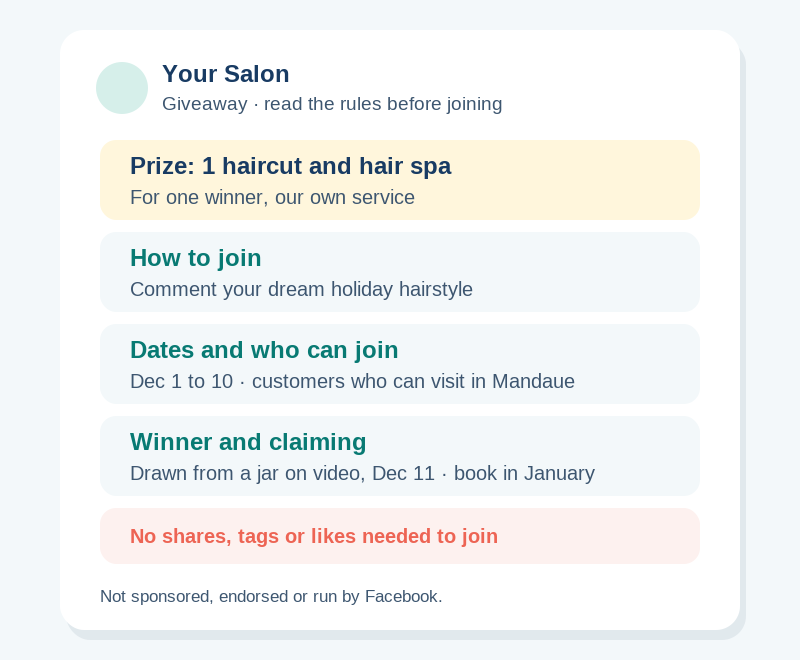
- Give away what you sell. A haircut and hair spa, a cake, a month of membership. People who want your prize are people who might pay for it later. A phone or a gift card attracts everyone.
- Ask for a comment, not a share. "Comment your favorite flavor" or "Tell us who you'd bring to your first class" fits Facebook's rules and tells you something about your customers.
- Keep it local. Say who can join: "Open to customers who can visit us in Mandaue" or "Pickup only, Talisay and Cebu City." This keeps the prize near your door.
- Write the rules first. Start and end dates, who can join, how to join, how the winner is picked, when you'll announce it, and how they claim it.
- Say Facebook isn't involved. Add one line: "This giveaway is not sponsored, endorsed or run by Facebook."
- Pick the winner fairly. Use a random draw you can show, like a recorded video of names drawn from a jar, and announce the winner on the same post.
- Plan the visit. Give the winner a claim date and a way to book. A prize that's never claimed brings you nothing.
Count what really happened
After the giveaway, look past the likes. Ask a few simple questions:
- How many new people messaged to ask about prices or bookings?
- Did the winner come in, and did they book again?
- Did anyone mention the giveaway when they ordered?
The easiest way to know is to ask every new customer how they found you. There's a simple way to keep track in 'How Did You Find Us?' The Question Worth Asking Every Customer.
If you'd rather spend the money on a discount than a prize, do the math first. The Salon Promo That Almost Lost Money shows how to check that an offer still leaves you something.
So, is it worth it?
A "like, share, tag" giveaway: usually no. It breaks Facebook's rules, and it mostly brings people who were never going to buy.
A small giveaway of your own service, open to people nearby, with clear rules and a comment to join: sometimes yes. Treat it as a way to get the right people through your door, not as a way to get likes.
Give new visitors somewhere to land
When a giveaway or a post brings new people to your page, they still need to find your prices, location and how to book. A website keeps all of that in one place, so the people who find you through a giveaway can become customers after it ends.
DotCity builds a website from the Facebook page you already have. You get a free preview within 48 hours, and your first month is free. After that, the Standard plan is ₱1,499 a month, with no setup fee. Hosting and updates are included, and you can pay by GCash.
- Message us on Messenger for a free preview: https://m.me/dotcity.ph
- Or try our free audit to see what to fix first: https://dotcity.ph/audit