
The Salon Promo That Almost Lost Money
Picture Lorna, who runs a three-chair salon in Mandaue. Lorna isn't a real client, but her week will sound familiar to anyone who runs a small shop.
Her Saturdays are full, with customers waiting on the bench outside. But on Tuesdays and Wednesdays, two of her three chairs sit empty most of the day, while the rent, lights and aircon cost the same.
So on a quiet Tuesday afternoon, Lorna opens Facebook and starts typing a post: "50% off all haircuts, Tuesdays and Wednesdays!"
She almost hits Post. Then she stops and picks up a notebook instead.
The first idea: half-price haircuts
Lorna's haircut is ₱250. Half price would be ₱125. It sounds generous, and it would probably bring people in.
But she has never written down what one haircut actually costs her. So she does it now:
- her stylist's share per haircut
- shampoo, conditioner and styling products
- a fair share of electricity and water
- the towel that goes to the laundry
It comes to about ₱120. That means each ₱250 haircut leaves her ₱130. At ₱125, she would keep ₱5.
Five pesos per customer, for a full haircut, a wash and a blow-dry. That is not a promo. That is free work.
The problem she hadn't thought of
Then Lorna thinks about who would see the post. Her regulars follow her page. Many of them come on Saturdays and pay full price without a second thought.
If half-price Tuesdays go up, some of them will simply move their visit. Her Saturday customer becomes a Tuesday customer, paying half. The salon gets no new business at all, just less money for the same haircuts.
A promo should bring in business you wouldn't get anyway. Moving her best customers to a cheaper day does the opposite.
Working out a better offer
Lorna starts again, this time with one clear goal: fill the empty chairs on slow weekdays, without cutting the price of her regular haircut.
Besides the haircut, she offers a hair spa for ₱350. It costs her around ₱150, mostly products and the stylist's time. Fewer people order it, but those who try it often come back.
Together, a haircut and a hair spa cost her about ₱270 and normally sell for ₱600. So she writes a bundle: haircut and hair spa for ₱450.
The numbers look very different:
- The customer saves ₱150, which feels like a real deal.
- Lorna keeps about ₱180 per bundle, more than a regular haircut alone.
- Her haircut price stays at ₱250, so nobody learns to wait for half off.
- Regulars who move to a Tuesday for the bundle still spend more than on a Saturday haircut.
- People try the hair spa, and some will order it again at full price.
Setting the limits
Her first post had no end date and no rules. This time she writes every term down first:
- Dates: October 21 to November 15. That ends well before the December rush, when she is busy anyway.
- Days: Tuesday to Thursday only.
- Limit: one per customer.
- How to get it: message the page to book a slot.
- Not valid with other promos.
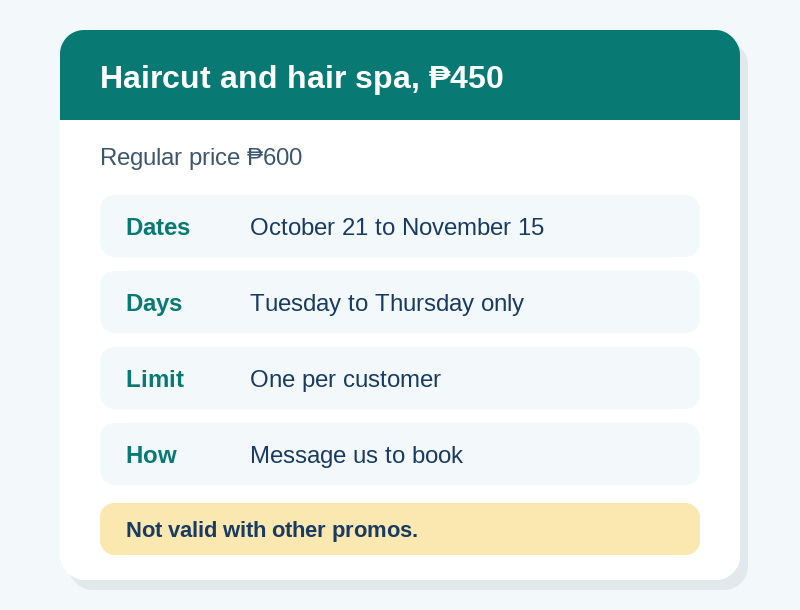
Then she saves the same wording as a reply in Messenger, so she can answer "Hi po, available pa ba yung promo?" in a few seconds. She tells her stylists the exact terms, so nobody promises a customer something different.
Keeping count
Lorna tapes a sheet of paper next to the cash box. Every time someone books the bundle, she writes down their name and one thing: new customer or regular.
When the promo ends, that sheet will tell her how many bundles she sold, how many went to new faces, and later, whether any came back at full price. Then she can run it again, change it, or drop it.
What Lorna's story teaches
The same steps work for a cake seller, a gym, a clinic or an aircon cleaning service.
- Know your cost per sale before you pick a discount. Write down materials, packaging, staff pay and delivery. Your discount must be smaller than what's left, with room to spare.
- Give the promo one job. Fill slow days, bring in new customers, or sell more per visit. Pick one, so you know what to measure.
- Ask who will really use it. If it's mostly regulars who would have paid full price, you are giving money away.
- Try a bundle before a price cut. A bundle makes each sale bigger, keeps your regular price safe, and gets people to try something new.
- Run it when you're quiet. A discount on a day you're already full costs you money and fills no empty seats.
- Write clear terms. Dates, days, limits, and how to claim it. Save them as a message reply and share them with your staff.
- Count as you go. A notebook tally is enough to tell whether the promo was worth it.
If your promo is a raffle, contest or game with prizes, check with your local DTI office before you launch. Some sales promotions in the Philippines need a DTI permit, and they can tell you if yours does.
If you're not sure your regular prices are clear to begin with, start with A Price List Customers Can Understand at a Glance. A promo works better when people can see what they're saving.
Give your promo a place to live
A promo post on Facebook slides down your page within days, and customers who see it late have to ask if it's still on. A website can show your current promo next to your regular prices, with the dates and terms, so people can check before they message you.
DotCity builds a website from the Facebook page you already have. You get a free preview within 48 hours, and your first month is free. After that, the Standard plan is ₱1,499 a month, with no setup fee. Hosting and updates are included, and you can pay by GCash.
- Message us on Messenger for a free preview: https://m.me/dotcity.ph
- Or try our free audit to see what to fix first: https://dotcity.ph/audit