
What to Charge for a Home Service Visit
A customer messages your aircon cleaning service: "Magkano po cleaning, one window type?" You reply ₱600. They book. Then you find out they live an hour away, across two traffic jams, on the third floor with no parking. By the time you get home, the ₱600 has mostly gone to gas, parking and your afternoon.
If you do home service, whether it's aircon cleaning, plumbing, massage, nails, pet grooming or appliance repair, the job itself is only part of the work. Getting there, setting up and going home all take time and money. Your price has to cover them, or you end up working for less than you think.
Here is a simple way to price home visits so they are fair to you and clear to the customer.
1. Know what one visit really costs you
Before you set prices, write down what a typical visit costs, apart from the job:
- gas, fare, tolls or parking
- travel time there and back
- time to set up and pack up
- materials you use, like cleaning chemicals, oil, towels or parts
- your helper's pay, if you bring one
You don't need exact numbers. A rough idea is enough to see that a visit across town costs you more than one down the street. That difference is what the rest of this post is about.
2. Draw your service area
Decide where you go and where you don't. Name the places customers know: barangays, cities, or landmarks.
For example, an aircon cleaner based in Mandaue might say:
- Regular area: Mandaue, Cebu City and Consolacion
- Extended area: Talisay, Lapu-Lapu and Liloan, with an added fee
- Outside the area: message first
This saves a lot of messages. A customer far outside your area knows before they ask, and you don't spend your day on trips that don't pay.
3. Add a transport fee for farther places
The simplest way is a flat fee by zone. Customers understand it, and you don't need to calculate anything on the spot.
- Within your regular area: free, or a small fixed fee
- Extended area: a set amount, for example ₱150 or ₱200
- Farther places: quote case by case
Pick amounts that fit your own costs. The point is to decide them once, write them down, and use the same numbers for everyone.
4. Set a minimum charge
A small job still takes a full trip. A massage therapist who travels 40 minutes for a 30-minute session, or a plumber who goes out to tighten one faucet, loses money on that visit.
A minimum charge fixes this. It might be "Minimum of two aircon units per visit" or "Home service minimum ₱800." If the job is smaller, the customer pays the minimum, or they add something else to reach it. Most customers accept this when they see it written down before they book.
5. Decide how you charge for checking first
Some jobs can't be priced until you see them. A plumber can't quote a leak inside a wall from a photo. An aircon technician can't promise a price for a unit that won't cool until they open it.
For these, many businesses charge an inspection or diagnostic fee. Make the rule clear:
- how much the inspection costs
- whether it is deducted if the customer goes ahead with the repair
- that you will give a price before you do any repair work
Customers worry about being surprised. Saying "We check first, tell you the price, and only start when you say yes" takes that worry away.
6. Be clear about materials and parts
Say what is included and what is extra. For example:
- "Price includes cleaning chemicals."
- "Gas top-up (freon) is extra, depending on the unit."
- "Parts are charged at cost. We'll show you the price before we buy."
A pet groomer can say whether shampoo and nail clipping are included. A massage service can say whether it brings its own bed or uses the customer's. Small details like these prevent arguments at the end of the visit.
7. Post your prices clearly
Once you've decided, put it all in one place. A simple price card might look like this:
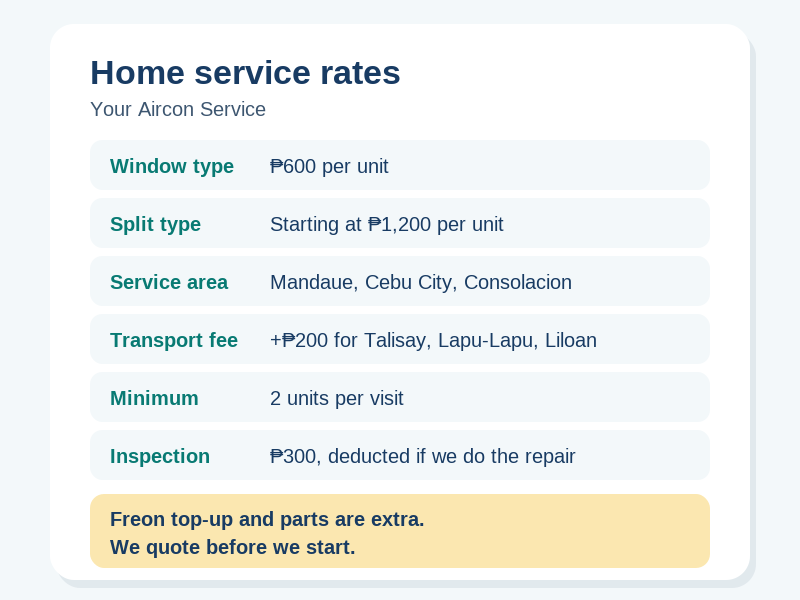
Put it in your Facebook page's intro or a pinned post, and save it as a reply in Messenger. When someone asks "Magkano po?", you can send the full picture in one tap, and they see the transport fee and minimum before they book, not after.
Use "starting at" for prices that change with size or condition, like "Split type cleaning, starting at ₱1,200." It's honest, and it leaves room for jobs that turn out bigger.
8. Quote before you go
Before any visit, send a short written quote in Messenger:
"Hi po! For 2 split type units in Talisay: cleaning ₱1,200 x 2 = ₱2,400, plus ₱200 transport fee. Total ₱2,600. Freon top-up is extra if needed, and we'll tell you before we do it. Schedule: Wednesday, 10 AM. Okay po ba?"
Ask the customer to send photos first when it helps: the unit's label, the leak, the size of the dog. Then confirm the address, a landmark, and whether there is parking or a gate guard you need to talk to.
A written quote protects both of you. If the job changes once you're there, explain why and agree on the new price before you continue.
Let customers see your prices and area first
Most home service messages start with the same three questions: how much, do you go to my area, and when are you free. A simple website can answer the first two before the customer messages you, with your price card, your service area and a booking request form in one place.
DotCity builds a website from the Facebook page you already have. You get a free preview within 48 hours, and your first month is free. After that, the Standard plan is ₱1,499 a month, with no setup fee. Hosting and updates are included, and you can pay by GCash.
- Message us on Messenger for a free preview: https://m.me/dotcity.ph
- Or try our free audit to see what to fix first: https://dotcity.ph/audit