
Bogus Buyers and Fake Orders: Warning Signs and What to Do
A customer messages your cake shop on a Tuesday. "Mine po! 2 dozen cupcakes for Saturday, chocolate, with names on top." You say yes, buy the ingredients, and spend Friday night piping names. Saturday comes. The customer doesn't reply. The cupcakes sit on your counter.
If you sell on Facebook and Messenger, you have met this buyer. Some call them joy reservers. They say "mine" and disappear. Others order cash on delivery and aren't home when the rider arrives. Some give an address that doesn't exist.
Most of your customers are honest. But one bogus order can wipe out the profit from several good ones. With Christmas orders starting to come in, now is a good time to set up a few simple habits.
Know the common kinds of bogus buyers
Most fake or failed orders fall into a few patterns:
- Joy reservers. They comment "mine" or "reserve po" and never pay or reply again.
- COD no-shows. They order cash on delivery, then refuse the package or can't be reached. You pay the rider for nothing.
- Fake or incomplete addresses. "Near the church, Lahug" is not enough for a rider to find anyone.
- Rush orders from brand-new accounts. A big order, needed today, from an account with no photo and no friends, who pushes you to skip your usual steps.
Ask for a deposit on made-to-order items
This is the most useful rule for anyone who makes things to order: cakes, custom shirts, flower arrangements, catering trays, personalized gifts.
If you spend money and time before the customer pays, ask for part of the payment first. Many sellers ask for 50 percent. Some ask for the full amount on small orders.
Say it plainly and early, before you start work:
"Thank you for your order! For custom orders, we ask for a 50% deposit to reserve your date. The balance is paid on pickup or delivery. You can pay by GCash or Maya."
Real customers understand this. A person who refuses any deposit for a custom cake was probably not going to pick it up.
For services, the same idea applies. An aircon cleaning service that sends two technicians across the city can ask for a small booking fee for first-time customers.
Confirm every order in writing
A lot of bogus orders are really confused orders. The customer thought Sunday, you thought Saturday, or the address was half-written.
Before you start work or book a rider, send one message with everything in it:
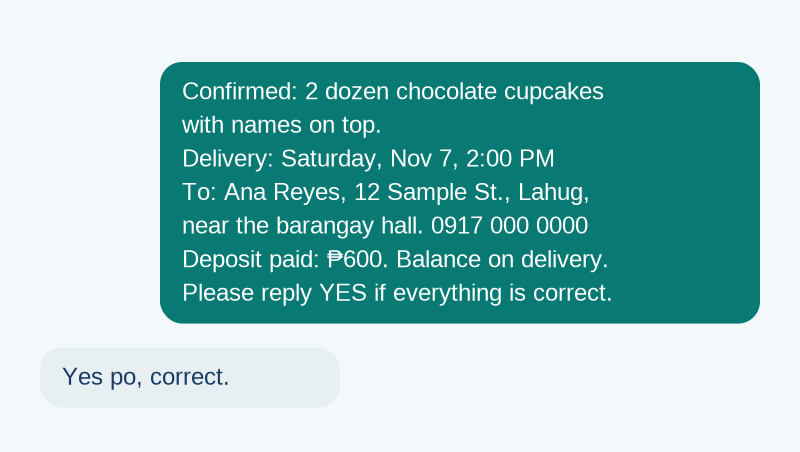
Ask the customer to reply "yes" or "correct." That reply shows they are paying attention, and gives you something to point back to if there is a mix-up.
For delivery, ask for:
- full name of the person receiving
- complete address with a landmark
- a mobile number that will be answered on the day
Take a quick look at the account
You don't need to investigate everyone. But for a large order, a rush order, or a COD order to a far address, spend thirty seconds on the buyer's profile.
Some things that are worth a second look:
- the account was made very recently
- there is no profile photo and almost no activity
- the name on the account doesn't match the name for delivery, and they can't explain why
- they want a big order today and push you to skip the deposit or confirmation
None of these proves anything. But if two or three show up together, it's fair to ask for full payment first, or to offer pickup instead of COD.
Be careful with COD
Cash on delivery is convenient for customers, but you pay for the delivery even when the buyer doesn't take the item. A few ways to lower the risk:
- Offer COD only for repeat customers, or only within a nearby area.
- Ask first-time COD buyers to pay the delivery fee in advance.
- Call or message the buyer an hour before the rider goes out.
- Keep a short private list of numbers that refused orders before.
Write a simple order policy
Customers follow rules they can see before they order. Write a short policy and post it where people look: pinned on your page, in your saved reply, and in your page's About section.
Keep it to a few lines, for example:
- "Custom orders need a 50% deposit to confirm."
- "Reservations without payment are held for 24 hours."
- "COD is available within the city for repeat customers."
- "Please message us at least a day ahead if you need to change your order."
The 24-hour rule is especially helpful against joy reservers. When someone says "mine" and goes quiet, you can release the item to the next person without guilt. You already told everyone the rule.
Stay polite, even when you suspect something
It's tempting to post screenshots of bogus buyers or reply angrily. Try not to. A calm page looks more trustworthy than a page full of call-outs.
When something doesn't feel right, a polite, firm message works:
"Thank you po! For first-time orders this size, we ask for full payment before we prepare it. Let us know if that works for you."
A real customer will usually say yes or ask a question. A bogus buyer usually goes quiet. Either way, you didn't lose anything, and you didn't insult anyone.
If an order does go wrong, write down what happened and adjust your policy.
Make your rules easy to find
Many of these problems shrink when customers can read your terms before they message you. A simple website can show your prices, your deposit rule, your delivery areas and your order steps on one page, so serious buyers arrive already knowing how it works.
DotCity builds a website from the Facebook page you already have. You get a free preview within 48 hours, and your first month is free. After that, the Standard plan is ₱1,499 a month, with no setup fee. Hosting and updates are included, and you can pay by GCash.
- Message us on Messenger for a free preview: https://m.me/dotcity.ph
- Or try our free audit to see what to fix first: https://dotcity.ph/audit